Showing posts with label astrophysics. Show all posts
Showing posts with label astrophysics. Show all posts
02 October, 2014
Black Holes and Gravitational Lensing
We end our week's discussion of black holes by looking at one of the ways we can "see" black holes - Gravitational lensing. This is the process where a black hole bends light around itself (light that doesn't get caught in the event horizon, of course!) the same way a lens bends light to form an image. When the earth, a black hole, and a galaxy are lined up just right, we can see amazingly distorted images that help us figure out where a black hole is and how strong its gravitational force is!

01 October, 2014
Massive Black Holes at the Centers of Galaxies
It's thought that many galaxies have massive black holes at their center, including our own. There's also now evidence that these massive black holes "grow up" with their host galaxy, affecting each other's size and shape. Volonteri & Ciotti present the details here.
30 September, 2014
Studying Black Holes
We saw last time that black holes are defined in principle as objects so massive that light cannot escape from them. There's also lots of properties we study about black holes, including their mass, their spin (which can be quite fast), and the size of their event horizon (the point of no return, where the escape speed equals the speed of light). Narayan reviews these properties for several observed black hole candidates.
29 September, 2014
Black Holes: What are they and how do we know they're there?
Black holes are one of the most popular scientific topics, and many of their properties are straightforward to understand with an intro-level understanding of physics. Starts With a Bang has an excellent article describing the basics of what a black hole is and how we look for them--even though, by definition, we can't see them directly.
If you add enough matter to a star, Siegel writes, the gravity would be so strong that "not even light would be able to escape. As Hawking (and others before him, going all the way back to John Michell in the 18th Century) have noted, this would create a black hole in space, where matter (and other forms of energy) could fall in, but nothing — no matter, no light, no nothing — could get out."
But what does this concept of "escaping gravity" mean? If you wanted to "escape" the earth's gravity, for example, how would you know you had accomplished it?
The answer lies in thinking about energy.
You probably learned at some point in school that energy primarily comes in two forms: kinetic energy (energy associated with movement) and potential energy (energy associated with where you are). These concepts help you determine, for example, how hard you would need to roll a ball if you wanted the ball to make it over a hill. The higher the hill, the more kinetic energy you'd have to give it at the beginning.
This relationship is determined by a law called the conservation of energy: The total amount of energy in the universe has to remain the same. In the case of "escaping gravity," that means you need enough kinetic energy when you launch from the earth to overcome to amount of potential energy you have at launch (the size of the hill). "Having enough kinetic energy" means having a fast enough speed, and it's actually pretty straightforward to calculate this escape speed.
So, when we say that "light can't escape a black hole," what we means is that the escape speed from a black hole is higher than the speed of light!
If you add enough matter to a star, Siegel writes, the gravity would be so strong that "not even light would be able to escape. As Hawking (and others before him, going all the way back to John Michell in the 18th Century) have noted, this would create a black hole in space, where matter (and other forms of energy) could fall in, but nothing — no matter, no light, no nothing — could get out."
But what does this concept of "escaping gravity" mean? If you wanted to "escape" the earth's gravity, for example, how would you know you had accomplished it?
The answer lies in thinking about energy.
You probably learned at some point in school that energy primarily comes in two forms: kinetic energy (energy associated with movement) and potential energy (energy associated with where you are). These concepts help you determine, for example, how hard you would need to roll a ball if you wanted the ball to make it over a hill. The higher the hill, the more kinetic energy you'd have to give it at the beginning.
This relationship is determined by a law called the conservation of energy: The total amount of energy in the universe has to remain the same. In the case of "escaping gravity," that means you need enough kinetic energy when you launch from the earth to overcome to amount of potential energy you have at launch (the size of the hill). "Having enough kinetic energy" means having a fast enough speed, and it's actually pretty straightforward to calculate this escape speed.
So, when we say that "light can't escape a black hole," what we means is that the escape speed from a black hole is higher than the speed of light!
04 September, 2014
Galactic doomsday is nigh!
And now, the topic you've waited all week for: The collision of our Milky Way (MW) galaxy with the Andromeda Galaxy (AG). For a while, we've known that MW and AG were moving toward each other; that's pretty easy to expect from the gravitational force between them, and the component toward us of AG's velocity has been pretty easy to measure. But until recently we did not know the perpendicular components of AG's velocity, which determines the difference between a collision and a miss.
Once these measurements were obtained, van der Marel et al (http://iopscience.iop.org/0004-637X/753/1/9/pdf/0004-637X_753_1_9.pdf) used two complementary methods to predict the future motion of AG relative to MW based on appropriate initial conditions (just like we discussed on Monday).
Below is a sample of their results for the Milky Way (labeled MW), Andromeda (labeled M31), and the Triangulum galaxy (labeled M33):
The red curve on the second graph is perhaps the most important, as it shows the separation between the Milky Way and Andromeda as a function of time (with t = 0 indicating today). As you can see, in about 4 billion years, we're in for a collision!
Here are more dramatic demonstrations: A video of the simulation and images of what it will look like from earth!
Once these measurements were obtained, van der Marel et al (http://iopscience.iop.org/0004-637X/753/1/9/pdf/0004-637X_753_1_9.pdf) used two complementary methods to predict the future motion of AG relative to MW based on appropriate initial conditions (just like we discussed on Monday).
Below is a sample of their results for the Milky Way (labeled MW), Andromeda (labeled M31), and the Triangulum galaxy (labeled M33):
 |
| Image credit: http://iopscience.iop.org/0004-637X/753/1/9/pdf/0004-637X_753_1_9.pdf |
 |
| Image credit: http://iopscience.iop.org/0004-637X/753/1/9/pdf/0004-637X_753_1_9.pdf |
Here are more dramatic demonstrations: A video of the simulation and images of what it will look like from earth!
02 September, 2014
Is our our Milky Way a galactic cannibal?
We saw last time that neighboring galaxies can "eat" each other through collisions and tidal forces, a process called galactic cannibalism. It is an amazing if violent process that seems to happen frequently, leading to the question, is our own Milky Way galaxy a galactic cannibal?
The short answer is yes. The motion of stars in our galaxy's outer halo suggests that the Milky Way has been absorbing smaller galaxies over the years. (There's also our impending collision with the Andromeda Galaxy, which we'll discuss later this week!)
If it makes you feel uneasy living in a universe of carnivorous galaxies, take heart: It looks like the earliest galaxies peacefully consumed their own gases to produce new stars at a remarkable pace.
The short answer is yes. The motion of stars in our galaxy's outer halo suggests that the Milky Way has been absorbing smaller galaxies over the years. (There's also our impending collision with the Andromeda Galaxy, which we'll discuss later this week!)
If it makes you feel uneasy living in a universe of carnivorous galaxies, take heart: It looks like the earliest galaxies peacefully consumed their own gases to produce new stars at a remarkable pace.
01 September, 2014
Galactic Cannibalism: How do we know it's happening?
Welcome to our first week of articles for the fall 2014 semester! This week's topic is galactic cannibalism, which is, in fact, as cool as it sounds.
You're probably familiar with the concept of a galaxy (a collection of stars, gas, and dark matter that generally swirl around in space). To look at pictures of galaxies and think of their sizes and ages, you might conclude that galaxies are immovable and unchanging constructs. After all, what force in the universe could be strong enough to move or mangle a galaxy?
You're probably familiar with the concept of a galaxy (a collection of stars, gas, and dark matter that generally swirl around in space). To look at pictures of galaxies and think of their sizes and ages, you might conclude that galaxies are immovable and unchanging constructs. After all, what force in the universe could be strong enough to move or mangle a galaxy?
The answer, it turns out, is other galaxies.
Because galaxies are so massive, the gravitational forces between them are strong enough to overcome the vast distance between them and create a notable acceleration. So, galaxies often hurl toward each other on a collision course. Even our own Milky Way Galaxy will collide with the Andromeda Galaxy in about 4.5 billion years. (We'll read more about our impending doom later!)
But that's not all: Because galaxies aren't rigid objects, but a collection of individual stars and gas clouds, galaxies on a collision course also distort each other.
Here's how it works: Suppose you're on earth as the Andromeda Galaxy approaches the Milky Way, and let's suppose the Milky Way is oriented such that Andromeda is approaching toward the Alpha Quadrant as depicted in
 |
| Image credit: http://www.freewebs.com/captaingestl/milkyway.gif |
Now, let's suppose you have a Borg friend (it's 4.5 billion years in the future; let's assume we've made peace with the Borg by then) sitting in the Delta Quadrant (on the opposite side of the galaxy from you). If you compare the force that each of you feels from Andromeda, your force will be much stronger than his, because the gravitational force decreases the farther away you are from the source. If you experience a greater force than your Borg friend, it means you (and, consequently, the earth and the sun) will be pulled toward Andromeda faster than your Borg friend, and the distance between you will increase! Andromeda will literally stretch the Milky way and tear pieces of it apart! (By the way, this is the same thing that happens on earth when the waters of the ocean accelerate toward the sun, producing tides!) Fear not, though! We'll be doing the same thing to Andromeda.
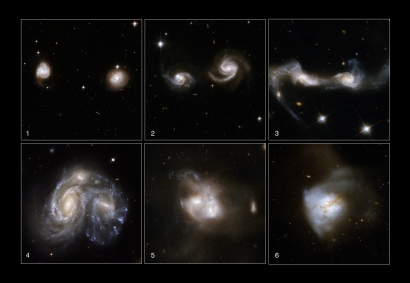
So, when one galaxy collides with another, the result can be quite violent! We call this process galactic cannibalism, and we can see it taking place when we see streams of gas and stars between galaxies, like in the images below:
So, when one galaxy collides with another, the result can be quite violent! We call this process galactic cannibalism, and we can see it taking place when we see streams of gas and stars between galaxies, like in the images below:
 |
| Image credit: http://sci.esa.int/hubble/42637-merger-stages-of-interacting-galaxies/ |
One great example of galactic cannibalism that we've been observing is between the Large Magellanic Cloud and the Small Magellanic Cloud, as described by Connors et al in http://arxiv.org/pdf/astro-ph/0402187.pdf. This work uses a program called GCD+ (http://mnras.oxfordjournals.org/content/340/3/908.full.pdf+html) to model the formation and evolution of galaxies. This program takes into account a number of processes that happen during a galaxy's lifetime, including "self-gravity, hydrodynamics, radiative cooling, [and] star formation."
In order to run the program, Connors et al fed a host of information into GCD+ from observations of the Magellanic Clouds (including their sizes, masses, and orbit characteristics). However, even all this information is not enough to predict the Clouds' behavior, so Connors et al had to run the program many times, each time feeding in slightly different values for parameters like the clouds' halo-to-disk mass ratios and velocity dispersion.
How did they know when they had arrived at the best set of parameter values? By comparing the results of their calculations with the stunning visual result of the Clouds' interaction: The Magellanic Stream, just like we talked about above!
 |
| Image credit: http://arxiv.org/pdf/astro-ph/0402187.pdf |
Here's a comparison of the neutral hydrogen flux in the Magellanic Stream as observed (on the left) and modeled by GCD+ (on the right). As you can see, the program produces a pretty good match, identifying the general shape and regions of greatest flux.
So, what did they learn from this simulation? 1. That there must have been an "encounter" (That's a polite way of hinting at galactic cannibalism!) between our galaxy and the Magellanic Clouds about 1.5 billion years ago and 2. The Large and Small Magellanic Clouds interacted with each other strongly about 200 million years ago.
We'll continue to look at galactic cannibalism this week by looking at how galactic cannibalism gave our galaxy its shape, looking at recent examples of how we can see this process now, and taking a deeper look into our future collision with Andromeda!
We'll continue to look at galactic cannibalism this week by looking at how galactic cannibalism gave our galaxy its shape, looking at recent examples of how we can see this process now, and taking a deeper look into our future collision with Andromeda!
Subscribe to:
Posts (Atom)