 |
| Image credit: http://www.photonics.com/images/WebExclusive/Omega%20Optical/Fig-3.jpg |
Showing posts with label quantum mechanics. Show all posts
Showing posts with label quantum mechanics. Show all posts
25 September, 2014
Spin-polarized states in graphene
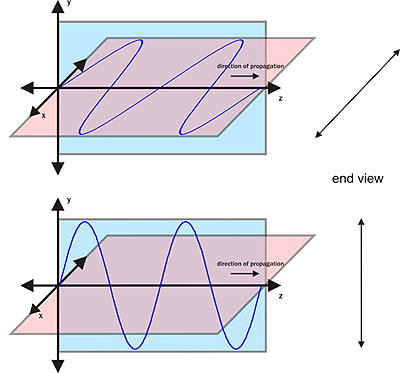
Today we look at an article about creating spin-polarized electron states in graphene. You might be familiar with the concept of polarization in the context of waves. There, the term refers to which direction a wave is oscillating:
Spin-polarization means much the same thing: You have a stream of electrons whose spins are aligned in a common direction. (Another term for "spin-polarized" is "spin-helical.") Since spintronics technology requires the manipulation of individual electron spins, you can imagine how important it is to set up spin-polarized electron states in graphene!

24 September, 2014
Graphene: More uses!
Graphene proves to have amazing uses. This article describes how graphene can be used as a tunneling barrier--a "wall" through which electrons can tunnel through at a specified rate.
Tunneling is the quantum mechanical process by which a particle shoots through a region of potential energy that classical mechanics says should be inaccessible to it because of conservation of energy. For example, suppose you kick a soccer ball (mass 0.4 kg) with a speed of 12 meters per second toward a hill that rises 10 meters high. Its kinetic energy would be 1/2*(0.4 kg)*(12 m/s)^2 = 29 joules. Since the soccer ball only has 29 joules of energy to climb with, once it reaches a maximum height of (29 J)/(0.4 kg * 9.8 m/s^2) = 7.4 meters, it would turn around. You'd have to kick the ball faster to make it over the 10-meter-high hill.
However, if you repeat the same experiment with an electron, quantum mechanics says the electron can still end up on the other side, even though it doesn't have "enough" energy to do so!
This process, called tunneling, is demonstrated beautifully by the simulation below:

Tunneling is the quantum mechanical process by which a particle shoots through a region of potential energy that classical mechanics says should be inaccessible to it because of conservation of energy. For example, suppose you kick a soccer ball (mass 0.4 kg) with a speed of 12 meters per second toward a hill that rises 10 meters high. Its kinetic energy would be 1/2*(0.4 kg)*(12 m/s)^2 = 29 joules. Since the soccer ball only has 29 joules of energy to climb with, once it reaches a maximum height of (29 J)/(0.4 kg * 9.8 m/s^2) = 7.4 meters, it would turn around. You'd have to kick the ball faster to make it over the 10-meter-high hill.
However, if you repeat the same experiment with an electron, quantum mechanics says the electron can still end up on the other side, even though it doesn't have "enough" energy to do so!
This process, called tunneling, is demonstrated beautifully by the simulation below:
| Click to Run |
23 September, 2014
Graphene - a technical overview
Today, we examine the technical details of graphene more deeply, through a helpful review article by Geim. This article makes a few references to crystal structure and effective mass:
- Crystal (AKA lattice) structure refers to the regularly repeating pattern of atoms in solid materials. Sodium chloride (NaCl, table salt), for example, has a cubic structure with Na and Cl atoms alternating at the corner and center of each cube. The shape of a lattice is often (including in Geim's article) noted using Miller indices.
- Effective mass refers to how an electron's motion is affected by its surroundings. If a single electron were on its own, its effective mass is its "normal" mass of 9.11x10^-31 kg. However, the presence of the lattice of atoms and the other electrons cause the electron to behave (i.e., respond to forces) as if it had a different mass.
18 September, 2014
Quantum weirdness in quantum computing
We've seen this week how weird things can get in quantum mechanics, and how useful that weirdness is. Today, we conclude this series by looking at how quantum weirdness is used in quantum computing.
Recently, researchers that University of Tokyo developed techniques for manipulating light between a particle-like state and a wave-like state, one of the greatest experimental goals of quantum mechanics:
The summary article linked above (full article here) describes the applications of this technology to qubits, which are the basis for quantum computers. Your (classical) computer operates by storing information in binary code: everything breaks down to a 1 or a 0, called bits. A quantum bit has the added property that the physical information storage is so small (like, an electron spin) that the rules of quantum mechanics apply, and the quantum bit (or "qubit"--see what physicists did there?) exists as a 1 and a 0 simultaneously. This property allows quantum computers to perform calculations with greatly reduced times; imagine, for example, a chess program that can sample all possible moves at the same time (instead of one at a time, which a classical computer must do).
Recently, researchers that University of Tokyo developed techniques for manipulating light between a particle-like state and a wave-like state, one of the greatest experimental goals of quantum mechanics:
 |
| Image credit: http://cdn.phys.org/newman/gfx/news/2014/11-experimental.jpg |
17 September, 2014
Quantum mechanics in drug design
We've seen that quantum mechanics produces some weird effects, namely...
- Energy comes in discrete lumps (instead of being smooth).
- Position is governed by probability (instead of being well-defined).
In a 2007 Drug Discovery Today article, Raha et al discuss how these properties are vital in drug design. Read over their article and post in the comments below an answer to the question: What is one example of how they use the weirdness of quantum mechanics (discrete energy and/or probabilistic position) in drug design?
16 September, 2014
Quantum Weirdness - Why don't we see it?
Last time, we looked at some of the weird properties of quantum mechanics, leaving us with the lingering question of, "Why don't we experience these weird properties in the everyday world?" For example...
- Why doesn't my energy come in discrete levels?
- Why is my position so easy to measure, and not spread out over the entire universe?
In 1991 issue of Physics Today, Zurek outlines an answer. As you look over his analysis, here are some of the concepts he discusses:
- The state |ψ> is what we, last time, referred to as the probability density of the particle's position. (Technically, you use |ψ> to calculate the probability density, and it can be rewritten as the probability density of any measurable quantity, but the simple explanation suffices for now.) The pointy shape | > that ψ is encased in is just a symbol that denotes what type of quantity it is (an infinite-dimensional vector of complex components, which is a member of a set called Hilbert space). Just think of it as a function--a very, very special function! (Long description here.)
- Spin-1/2 is related to what we discussed in our series about spintronics, that protons and electrons (and, therefore, atoms) have an inherent property whose equations look a lot like the particles are spinning. Because spin is a quantum mechanical property, it comes in discrete lumps, and for protons and electrons, the spin (as measured along a selected axis) can take on two values (in units of Planck's constant): +1/2 and -1/2. These values lead to the colloquial terms "spin-up" and "spin-down," and electron or proton spin is a "simple" problem to study, since the state |ψ> need only specify two numbers: α (the probability of the particle being spin-up) and β (the probability of the particle being spin-down).
The mathematics in Zurek's article can get a bit cumbersome, so if you're new to quantum mechanics, focus on his commentary! Have a question about a step he takes or what a symbol means? Post it in the comments below!
15 September, 2014
Quantum Weirdness: Why bother?
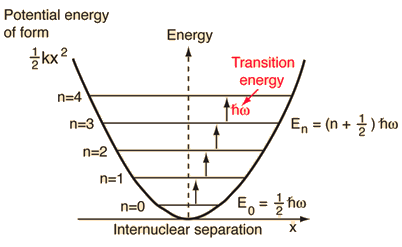
This week, we take a look at some of the strange behaviors in the universe that arise because of quantum mechanics. If you've studied physics for more than a semester, or have watched any physics documentaries on TV, you've probably heard of quantum mechanics and its two types of weird behavior, which apply in the world of very small particles or very cold temperatures:
- Physics properties that we, in the everyday world, think of as smoothly varying (most notably, energy) occur in discrete lumps (or "quanta"--hence the name "quantum mechanics"):
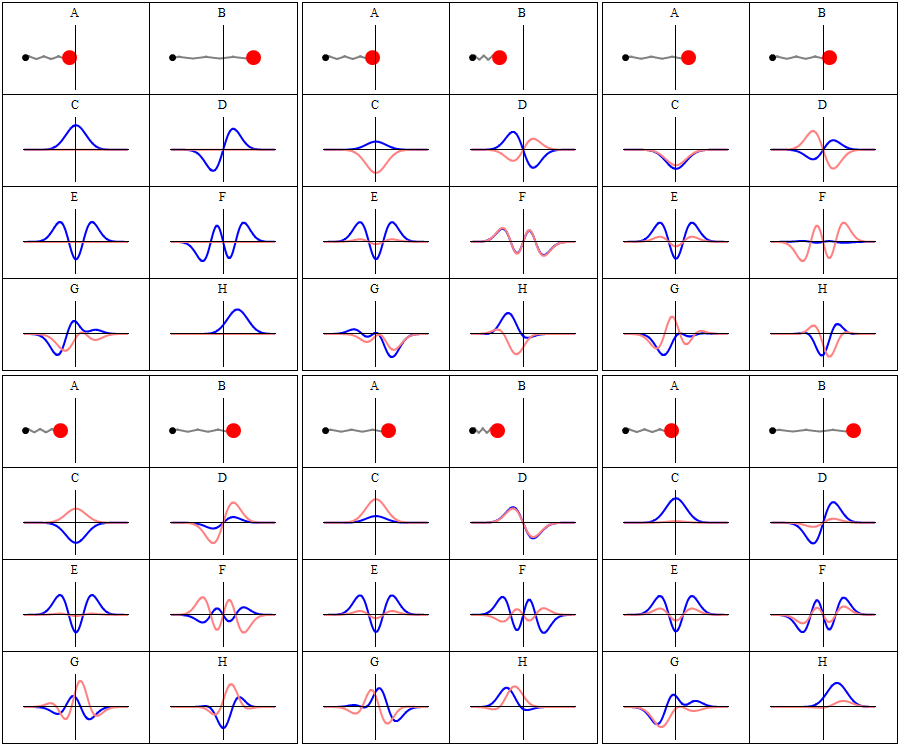
Image credit: http://hyperphysics.phy-astr.gsu.edu/hbase/quantum/imgqua/hosc9.gif - Physics properties that we, in the everyday world, think of as well-defined and localized (most notably, position and momentum) are actually spread out or "fuzzy:"
Image credit: http://upload.wikimedia.org/wikipedia/commons/9/90/QuantumHarmonicOscillatorAnimation.gif

The Royal Society has a wonderful brief answer to this question, pointing out that studying quantum mechanics gives us...
- A better understanding of chemistry.
- A basis for working with radioactivity.
- The laser!
- The physical mechanism by which our eyes work.
- Digital cameras.
- Scanning tunneling microscopes.
- Encryption (coming soon!).
- Quantum computing (coming soon!).
This week, we'll look more deeply at the technological applications of quantum mechanics to continue to answer this question.
11 September, 2014
Spintronics - recent developments
Let's wrap up our discussion of spintronics with a look at some recent developments in the field: creating spin-valve devices in graphene.
Graphene is a relatively new wonder-material that we'll discuss later this semester. Graphene comes in sheets made of single layers of carbon atoms:
Graphene is extremely strong and extremely conductive of both electric current and heat.
A spin-valve device is multiple conducting materials stacked in layers whose combined resistivity changes drastically depending on whether their magnetizations are parallel or antiparallel. (Sound familiar?) In other words, this device permits or prevents current passing through with a simple switch of the magnetic field, just like a faucet permits or prevents water passing through with the turn of a handle.
In http://arxiv.org/pdf/1407.1439.pdf, Fu et al discuss the creation of spin-valve devices with graphene using chemical vapor deposition, which assembles nanoscopic devices one layer at a time. Have a look to see spin valves in action!
Graphene is a relatively new wonder-material that we'll discuss later this semester. Graphene comes in sheets made of single layers of carbon atoms:
 |
| Image credit: http://upload.wikimedia.org/wikipedia/commons/thumb/9/9e/Graphen.jpg/800px-Graphen.jpg |
A spin-valve device is multiple conducting materials stacked in layers whose combined resistivity changes drastically depending on whether their magnetizations are parallel or antiparallel. (Sound familiar?) In other words, this device permits or prevents current passing through with a simple switch of the magnetic field, just like a faucet permits or prevents water passing through with the turn of a handle.
In http://arxiv.org/pdf/1407.1439.pdf, Fu et al discuss the creation of spin-valve devices with graphene using chemical vapor deposition, which assembles nanoscopic devices one layer at a time. Have a look to see spin valves in action!
10 September, 2014
Spintronics - Making it work!
This week, we're learning about spintronics - manipulating the spins of individual electrons to store information. Unfortunately, electron spins tend to "reset" (lose the spin orientation that we set up) after only a hundred picoseconds (a picosecond = 10^-12 seconds), which is too short to be read by our computer processors. (Remember: period = 1/frequency! So, for example, a 1 gigahertz processor would need the spins to have a lifetime of at least 1/(10^9 Hz) = 10^-9 seconds.)
Fortunately, in 2012, IBM announced they had successfully synchronized the spins of clusters of electrons, increasing the spin lifetime by a factor of 30.
Here's an example of their data (with time increasing as you move up the vertical axis), showing that the spins remain coherent for just over a nanosecond - enough time to be useful to a 1 gigahertz processor!
Fortunately, in 2012, IBM announced they had successfully synchronized the spins of clusters of electrons, increasing the spin lifetime by a factor of 30.
Here's an example of their data (with time increasing as you move up the vertical axis), showing that the spins remain coherent for just over a nanosecond - enough time to be useful to a 1 gigahertz processor!
 |
| http://www.computerworld.com/common/images/site/features/2012/06/Spintronics%20photo1.jpeg |
09 September, 2014
Spintronics - some important concepts
Last time, we introduced the concept of spintronics - manipulating spins of individual electrons for applications in memory storage and quantum computing. Today, we take a more detailed look at the physics concepts and material properties involved in spintronics. Science published a great review article about this topic in 2001, available at http://www.dtic.mil/cgi-bin/GetTRDoc?AD=ADA516289.
Here are some concepts discussed in the article that you might like some additional resources to learn about:
Giant Magnetoresistance (GMR): Magnetoresistance (giant or small) is when a material's electrical resistance increases when the current runs parallel to an applied magnetic field. Magnetoresistance can therefore be used to interface with magnetic storage devices, but ordinary-sized magnetoresistance isn't strong enough to do the job. GMR, on the other hand, employs quantum mechanical concepts to introduce a large change in resistance, such that the resistance change can be used to read information stored in magnetic memory.
Ferromagnets: In elementary school, you might have learned to call these "permanent magnets"--materials that retain their magnetization even when there's no external magnetic field to keep all the spins in the same direction. But ferromagnets do have a weakness; if you heat them beyond their Curie temperature, they'll lose their magnetic ordering! So, when we design magnetic storage devices, it's important to know how hot they can get!
Semiconductors: On first pass, a semiconducting material is a pretty straightforward concept: It has a resistivity somewhere between the high resistivity of an insulator (letting no electrons through) and the low resistivity of a metal (letting all the electrons through). The reason a semiconductor behaves this way, though, is that its electronic band structure (the configuration of quantum states that the electrons are allowed to be in) has a small gap that can be easily manipulated:
If you found the article above interesting, check out these even deeper (i.e., lengthier) reviews at http://arxiv.org/pdf/cond-mat/0405528.pdf, http://arxiv.org/ftp/arxiv/papers/0711/0711.1461.pdf, and http://arxiv.org/pdf/0801.0145v1.pdf.
Here are some concepts discussed in the article that you might like some additional resources to learn about:
Giant Magnetoresistance (GMR): Magnetoresistance (giant or small) is when a material's electrical resistance increases when the current runs parallel to an applied magnetic field. Magnetoresistance can therefore be used to interface with magnetic storage devices, but ordinary-sized magnetoresistance isn't strong enough to do the job. GMR, on the other hand, employs quantum mechanical concepts to introduce a large change in resistance, such that the resistance change can be used to read information stored in magnetic memory.
Ferromagnets: In elementary school, you might have learned to call these "permanent magnets"--materials that retain their magnetization even when there's no external magnetic field to keep all the spins in the same direction. But ferromagnets do have a weakness; if you heat them beyond their Curie temperature, they'll lose their magnetic ordering! So, when we design magnetic storage devices, it's important to know how hot they can get!
Semiconductors: On first pass, a semiconducting material is a pretty straightforward concept: It has a resistivity somewhere between the high resistivity of an insulator (letting no electrons through) and the low resistivity of a metal (letting all the electrons through). The reason a semiconductor behaves this way, though, is that its electronic band structure (the configuration of quantum states that the electrons are allowed to be in) has a small gap that can be easily manipulated:
 |
| Image credit: http://upload.wikimedia.org/wikipedia/commons/thumb/0/0b/Band_gap_comparison.svg/350px-Band_gap_comparison.svg.png |
If you found the article above interesting, check out these even deeper (i.e., lengthier) reviews at http://arxiv.org/pdf/cond-mat/0405528.pdf, http://arxiv.org/ftp/arxiv/papers/0711/0711.1461.pdf, and http://arxiv.org/pdf/0801.0145v1.pdf.
11 July, 2014
Welcome! About Phys dot JU...
Welcome to Phys dot JU! The purpose of this blog is tied to the twofold meaning of its name:
First, the "dot" connotes a Web presence, as it has for a few decades now. This blog represents the Web presence of the JU Physics Department. We use this space to discuss class topics, announce department events, and share news about our faculty & alumni.
Second, to physicists (and mathematicians, engineers, etc.), "dot" also references the dot product (AKA scalar product) between two vectors. The dot product is an extremely useful tool, as it shows you how much two vectors overlap (or, "how alike they are"). (It's so useful, quantum mechanics extends it to infinite-dimensional vectors and even functions!) This blog is also a venue for our physics faculty and students to explore the overlap between their studies at JU and research & news from the broader physics community.
Thank you for visiting! For updates, you can follow the JU Physics Department on Twitter and Facebook.
First, the "dot" connotes a Web presence, as it has for a few decades now. This blog represents the Web presence of the JU Physics Department. We use this space to discuss class topics, announce department events, and share news about our faculty & alumni.
Second, to physicists (and mathematicians, engineers, etc.), "dot" also references the dot product (AKA scalar product) between two vectors. The dot product is an extremely useful tool, as it shows you how much two vectors overlap (or, "how alike they are"). (It's so useful, quantum mechanics extends it to infinite-dimensional vectors and even functions!) This blog is also a venue for our physics faculty and students to explore the overlap between their studies at JU and research & news from the broader physics community.
Thank you for visiting! For updates, you can follow the JU Physics Department on Twitter and Facebook.
Subscribe to:
Posts (Atom)