Showing posts with label learning. Show all posts

23 October, 2014

Learning from Wikipedia

This week, we're looking at on-line resources that can help students learn physics. Today, we're going to look at a web resource that is supposedly forbidden for students.

That's right: Wikipedia.

Professors warn students about Wikipedia, and rightly so: Because anyone can edit Wikipedia, it's vulnerable to incorrect information. (But don't worry; there's a Wikipedia article about Wikipedia's accuracy.) So most professors will agree that Wikipedia is not an acceptable reference to cite in an academic paper.

However, that doesn't mean students can't learn from Wikipedia, for three reasons:

  1. While there are people who will spread misinformation on Wikipedia, there are just as many who will jump in to make corrections. Caution--not outright mistrust--is the name of the game.
  2. The summaries of complicated topics like physics are, generally, very well written, with helpful diagrams, animations, etc.
  3. Wikipedia articles are required to cite external sources. So, when you've finished reading an article, you can check its correctness in these sources (which usually are the references you want to cite in an academic paper).
Let's take, for example, the Wikipedia article about physics' particle in a box problem. Could a malicious user come along and ruin this article? Yes! Will the misinformation remain for long, with professors and students turning to it to check equations, look for examples & animations, and refresh their understanding of the problem? No!

The description is well written, with a nice qualitative introduction, followed by a direct solution of the one-dimensional problem organized in order of increasing complexity of topic filled with links to other articles that explain the technical terms employed, capped off with a discussion of higher-dimensional problems, based on the preceding one-dimensional discussion. The text is accompanied by helpful graphics and animations. At each step along the way, a math-equipped reader can check to make sure that the content is sound and edit as required.

And at the end of the article are references--good references available on-line or at a library.

So, can you learn physics from Wikipedia? Absolutely! But more importantly, you can learn how to learn, by reading carefully and checking the information along the way.

22 October, 2014

Physics on Reddit

Reddit advertises itself as "the front page of the internet." It's an apt moniker: Reddit shows you what it's users find interesting because users can up-vote or down-vote any post. More specifically, it shows you what it's users find interesting within different subjects, called subreddits. The subreddits continue to break up fractally, such that you can find a group of people discussing just about anything. And if you find a sub-sub-sub-sub-topic that doesn't have a subreddit, you can make one.

Here's CGP Grey's explanation of Reddit and why it's an awesome place to learn new subjects:


So, for example, Reddit is a great place to learn physics, because physicists interested in discussing physics on-line tend to frequent the physics subreddit. Users post links to articles and pictures, and host "AMAs" (Ask Me Anything), in which a professional physicist hosts an open forum regarding their work. Here's a recent one regarding climate change, or one about earthquakes.

So, what interesting physics topics do you see on Reddit?

21 October, 2014

What if ridiculous questions were addressed by serious physics... and stick figures?

This week, we're highlighting resources that can help students learn physics. Yesterday, we discussed HyperPhysics, an on-line concept map, making it a great complement to your physics textbook. Now imagine what if your physics textbook illustrated the concepts of physics with ridiculous yet intriguing examples, such as "What would happen if you tried to hit a baseball pitched at 90% the speed of light?" or "How hard would a puck have to be shot to be able to knock the goalie himself backwards into the net?" or "How quickly would the ocean's drain if a circular portal 10 meters in radius leading into space was created at the bottom of Challenger Deep, the deepest spot in the ocean? How would the Earth change as the water is being drained?" That's precisely what Randall Munroe, the creator of the web comic xkcd.com, sets out to do each week in his what if? blog (and now book).

Each week, what if? addresses a reader-submitted question with equal parts accuracy and ridiculousness. (Some readers may find this familiar.) Munroe explains the physics principles behind the scenario in question, shows or describes the calculations involved in determining an answer, and then extrapolates beyond the original question to ludicrous extreme cases.

Discussions like these help students learn physics in a number of ways:

  1. By showing that physicists don't always take themselves/their subject/life super seriously.
  2. By showing that our universe can be a weird place and physics explains that weirdness.
  3. By demonstrating that, with just a few core physics concepts, one can study and make predictions regarding physical scenarios, no matter how strange.
So, what's your favorite scenario discussed on what if? What's a scenario you'd like to send in?

20 October, 2014

So you want to learn some physics...


Physics is a subject that many students find fascinating yet difficult to learn. Sometimes, all it takes is "just the right presentation" of material and something in the learner's mind clicks, and they're eager and ready to learn additional concepts.

So, it's important that physics learners have access to multiple avenues of learning (class presentation, textbook, demos, laboratory activities, student-student interaction, tutoring, office hours, simulations...). This week, we're going to look at four on-line resources that many physics learners find helpful.

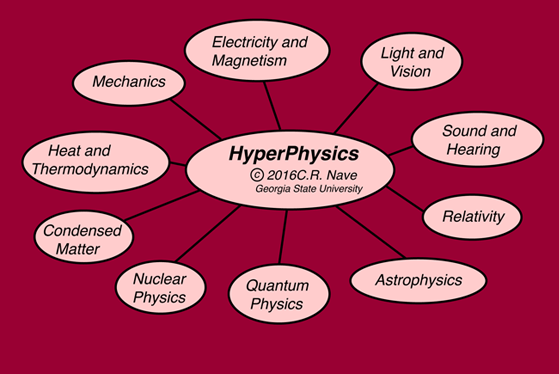
First up is HyperPhysics, a web-based network of physics topics that allows students to explore connections between physics topics, read sample problems, and investigate scenarios with built-in calculators.

HyperPhysics is unique in that it's organized as a concept map, in which ideas are represented by bubbles and the relationships between them are represented by lines connecting the bubbles. You can begin exploring from the top-level bubbles on the home page:


...or by searching for a particular topic (say, collisions) and seeing how it's related to other topics and examples:


HyperPhysics is also available as an iOS app. 

So, take a look around! Search for what you're currently learning in your physics class. What new relationships do you see? What new topics had you never heard of before navigating the concept map?

27 August, 2014

JU Physics alum begins teaching at Georgia Southern University

Congratulations to JU Physics alum Ashley August, who recently graduated with her Master of Science in Teaching at the University of Florida and is beginning a new job teaching physics at Georgia Southern University!

Many in the JU community will remember August as a member of JU's volleyball team and an exciting presence in the classroom. Now, she is looking forward to sharing that excitement with over 170 students at GSU this fall.

August says that she first became interested in teaching when she was a student in second grade and her teacher directed the class in a common exercise: Students exchanging papers to grade. "I don't know what happened," August says, "I just got so excited. I love grading papers." She later found an interest in physics, and found the two passions combine in a call to teach physics.

We asked August what she learned in her MST program that she plans to put to use at GSU. She says she learned that "if I didn't know something, which happened more often than not, I found that I was capable of learning on my own. I knew that before, but this was at a whole new level." She describes this new confidence as "quite a valuable lesson" that she plans to pass on to her students.

August also learned a great deal about teaching based on students' learning needs. "Everybody comes from a different background [with] different skills," she says. "It can affect a student... I think at GSU, it's going to be my job to be observant of my students and be willing to accommodate the learning style that each of them has."

We also asked August what she learned at JU that has been most helpful to her and that she plans to pass on to her students. She says she learned that one does not have to teach the same way every time: "There are no limits in the classroom... Being adventurous is a good thing because students see that it's new as well and get excited."

Through her interactions with JU professors outside the classroom, August also learned that "Teachers are people too... When you had us in office hours, it was like you still had that authority, but you became almost like a student and were welcoming and kind and wanted us to ask questions." From this experience, August says she wants students to understand that there are things that happen outside the classroom that affect one's academic performance.

Finally, August learned at JU that, when teaching, it's important to be oneself. "I need to be okay with learning what my teaching style is... and try to have some fun!" She says that, in doing so, teachers will "inspire and motivate in any way that we can."

We thank Ashley for talking with us about this next adventure and wish her the best!