Showing posts with label energy levels. Show all posts
Showing posts with label energy levels. Show all posts
09 October, 2014
Finding Water Vapor on an Exoplanet
One of the greatest discoveries about an exoplanet was the recent confirmation of water vapor on HAT-P-11b. This discovery is the result of combined observations from three different space telescopes. The data from these observations are processed using transmission spectroscopy, which you might be familiar with in an intro physics or chemistry class: The energy levels of a given compound permit the transmission of only specific wavelengths of light; by examining the wavelengths that transmit through a material, we can determine what the material is made of.

16 September, 2014
Quantum Weirdness - Why don't we see it?
Last time, we looked at some of the weird properties of quantum mechanics, leaving us with the lingering question of, "Why don't we experience these weird properties in the everyday world?" For example...
- Why doesn't my energy come in discrete levels?
- Why is my position so easy to measure, and not spread out over the entire universe?
In 1991 issue of Physics Today, Zurek outlines an answer. As you look over his analysis, here are some of the concepts he discusses:
- The state |ψ> is what we, last time, referred to as the probability density of the particle's position. (Technically, you use |ψ> to calculate the probability density, and it can be rewritten as the probability density of any measurable quantity, but the simple explanation suffices for now.) The pointy shape | > that ψ is encased in is just a symbol that denotes what type of quantity it is (an infinite-dimensional vector of complex components, which is a member of a set called Hilbert space). Just think of it as a function--a very, very special function! (Long description here.)
- Spin-1/2 is related to what we discussed in our series about spintronics, that protons and electrons (and, therefore, atoms) have an inherent property whose equations look a lot like the particles are spinning. Because spin is a quantum mechanical property, it comes in discrete lumps, and for protons and electrons, the spin (as measured along a selected axis) can take on two values (in units of Planck's constant): +1/2 and -1/2. These values lead to the colloquial terms "spin-up" and "spin-down," and electron or proton spin is a "simple" problem to study, since the state |ψ> need only specify two numbers: α (the probability of the particle being spin-up) and β (the probability of the particle being spin-down).
The mathematics in Zurek's article can get a bit cumbersome, so if you're new to quantum mechanics, focus on his commentary! Have a question about a step he takes or what a symbol means? Post it in the comments below!
15 September, 2014
Quantum Weirdness: Why bother?
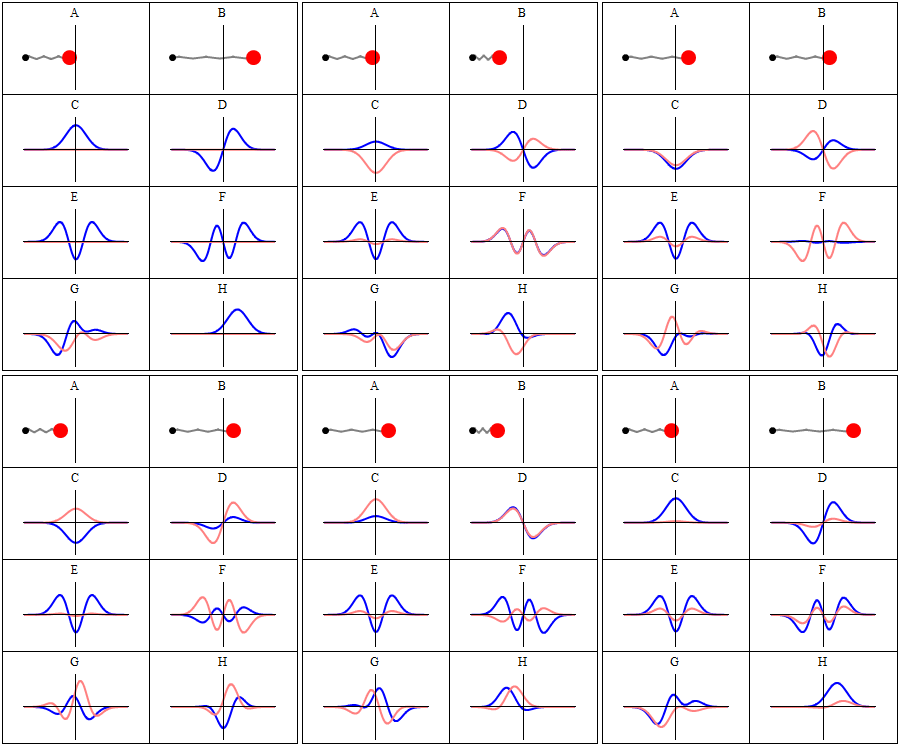
This week, we take a look at some of the strange behaviors in the universe that arise because of quantum mechanics. If you've studied physics for more than a semester, or have watched any physics documentaries on TV, you've probably heard of quantum mechanics and its two types of weird behavior, which apply in the world of very small particles or very cold temperatures:
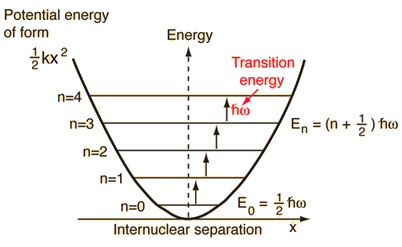
- Physics properties that we, in the everyday world, think of as smoothly varying (most notably, energy) occur in discrete lumps (or "quanta"--hence the name "quantum mechanics"):
Image credit: http://hyperphysics.phy-astr.gsu.edu/hbase/quantum/imgqua/hosc9.gif - Physics properties that we, in the everyday world, think of as well-defined and localized (most notably, position and momentum) are actually spread out or "fuzzy:"
Image credit: http://upload.wikimedia.org/wikipedia/commons/9/90/QuantumHarmonicOscillatorAnimation.gif
The Royal Society has a wonderful brief answer to this question, pointing out that studying quantum mechanics gives us...
- A better understanding of chemistry.
- A basis for working with radioactivity.
- The laser!
- The physical mechanism by which our eyes work.
- Digital cameras.
- Scanning tunneling microscopes.
- Encryption (coming soon!).
- Quantum computing (coming soon!).
This week, we'll look more deeply at the technological applications of quantum mechanics to continue to answer this question.
Subscribe to:
Comments (Atom)