 |
| Image credit: http://www.photonics.com/images/WebExclusive/Omega%20Optical/Fig-3.jpg |
Showing posts with label graphene. Show all posts
Showing posts with label graphene. Show all posts
25 September, 2014
Spin-polarized states in graphene
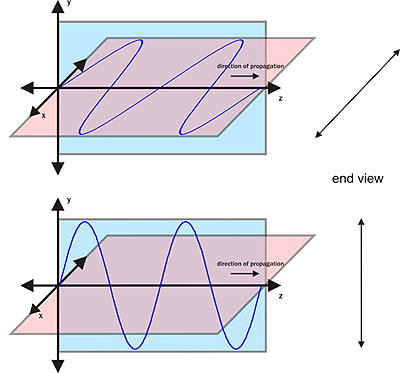
Today we look at an article about creating spin-polarized electron states in graphene. You might be familiar with the concept of polarization in the context of waves. There, the term refers to which direction a wave is oscillating:
Spin-polarization means much the same thing: You have a stream of electrons whose spins are aligned in a common direction. (Another term for "spin-polarized" is "spin-helical.") Since spintronics technology requires the manipulation of individual electron spins, you can imagine how important it is to set up spin-polarized electron states in graphene!

24 September, 2014
Graphene: More uses!
Graphene proves to have amazing uses. This article describes how graphene can be used as a tunneling barrier--a "wall" through which electrons can tunnel through at a specified rate.
Tunneling is the quantum mechanical process by which a particle shoots through a region of potential energy that classical mechanics says should be inaccessible to it because of conservation of energy. For example, suppose you kick a soccer ball (mass 0.4 kg) with a speed of 12 meters per second toward a hill that rises 10 meters high. Its kinetic energy would be 1/2*(0.4 kg)*(12 m/s)^2 = 29 joules. Since the soccer ball only has 29 joules of energy to climb with, once it reaches a maximum height of (29 J)/(0.4 kg * 9.8 m/s^2) = 7.4 meters, it would turn around. You'd have to kick the ball faster to make it over the 10-meter-high hill.
However, if you repeat the same experiment with an electron, quantum mechanics says the electron can still end up on the other side, even though it doesn't have "enough" energy to do so!
This process, called tunneling, is demonstrated beautifully by the simulation below:

Tunneling is the quantum mechanical process by which a particle shoots through a region of potential energy that classical mechanics says should be inaccessible to it because of conservation of energy. For example, suppose you kick a soccer ball (mass 0.4 kg) with a speed of 12 meters per second toward a hill that rises 10 meters high. Its kinetic energy would be 1/2*(0.4 kg)*(12 m/s)^2 = 29 joules. Since the soccer ball only has 29 joules of energy to climb with, once it reaches a maximum height of (29 J)/(0.4 kg * 9.8 m/s^2) = 7.4 meters, it would turn around. You'd have to kick the ball faster to make it over the 10-meter-high hill.
However, if you repeat the same experiment with an electron, quantum mechanics says the electron can still end up on the other side, even though it doesn't have "enough" energy to do so!
This process, called tunneling, is demonstrated beautifully by the simulation below:
| Click to Run |
23 September, 2014
Graphene - a technical overview
Today, we examine the technical details of graphene more deeply, through a helpful review article by Geim. This article makes a few references to crystal structure and effective mass:
- Crystal (AKA lattice) structure refers to the regularly repeating pattern of atoms in solid materials. Sodium chloride (NaCl, table salt), for example, has a cubic structure with Na and Cl atoms alternating at the corner and center of each cube. The shape of a lattice is often (including in Geim's article) noted using Miller indices.
- Effective mass refers to how an electron's motion is affected by its surroundings. If a single electron were on its own, its effective mass is its "normal" mass of 9.11x10^-31 kg. However, the presence of the lattice of atoms and the other electrons cause the electron to behave (i.e., respond to forces) as if it had a different mass.
22 September, 2014
Introducing graphene
This week, we take a look at one of the greatest developments in physics over the last decade: Graphene.
The graphite in your pencil is made of carbon atoms arranged in a repeating hexagon pattern called a lattice. The layers of this lattice are very loosely bound, which is why it makes such a great writing implement: The layers shed off as you drag the pencil across paper.
Graphene is what you get if you remove a single layer of graphite, producing a purely two-dimensional material.
CNN has a great interview with the physicists who discovered graphene, along with a great series of infographics that describe some of the amazing properties of this this wonder material and explain what it's useful for.
The graphite in your pencil is made of carbon atoms arranged in a repeating hexagon pattern called a lattice. The layers of this lattice are very loosely bound, which is why it makes such a great writing implement: The layers shed off as you drag the pencil across paper.
Graphene is what you get if you remove a single layer of graphite, producing a purely two-dimensional material.
CNN has a great interview with the physicists who discovered graphene, along with a great series of infographics that describe some of the amazing properties of this this wonder material and explain what it's useful for.
11 September, 2014
Spintronics - recent developments
Let's wrap up our discussion of spintronics with a look at some recent developments in the field: creating spin-valve devices in graphene.
Graphene is a relatively new wonder-material that we'll discuss later this semester. Graphene comes in sheets made of single layers of carbon atoms:
Graphene is extremely strong and extremely conductive of both electric current and heat.
A spin-valve device is multiple conducting materials stacked in layers whose combined resistivity changes drastically depending on whether their magnetizations are parallel or antiparallel. (Sound familiar?) In other words, this device permits or prevents current passing through with a simple switch of the magnetic field, just like a faucet permits or prevents water passing through with the turn of a handle.
In http://arxiv.org/pdf/1407.1439.pdf, Fu et al discuss the creation of spin-valve devices with graphene using chemical vapor deposition, which assembles nanoscopic devices one layer at a time. Have a look to see spin valves in action!
Graphene is a relatively new wonder-material that we'll discuss later this semester. Graphene comes in sheets made of single layers of carbon atoms:
 |
| Image credit: http://upload.wikimedia.org/wikipedia/commons/thumb/9/9e/Graphen.jpg/800px-Graphen.jpg |
A spin-valve device is multiple conducting materials stacked in layers whose combined resistivity changes drastically depending on whether their magnetizations are parallel or antiparallel. (Sound familiar?) In other words, this device permits or prevents current passing through with a simple switch of the magnetic field, just like a faucet permits or prevents water passing through with the turn of a handle.
In http://arxiv.org/pdf/1407.1439.pdf, Fu et al discuss the creation of spin-valve devices with graphene using chemical vapor deposition, which assembles nanoscopic devices one layer at a time. Have a look to see spin valves in action!
Subscribe to:
Comments (Atom)